


 Global Offices


How to Choose the Most Suitable Lecture Hall Seating for Different Classrooms?
Selecting lecture hall seating is far more than a simple furniture purchase. It fundamentally shapes student concentration, influences the teacher-learner interaction, and directly impacts how efficiently instructional space is utilized over time.
There are diverse classroom archetypes, from tiered lecture halls to flat-floor seminar rooms and collaborative studios. So how do you identify the precise educational seating solutions that align with diverse instructional goals?
5 Core Dimensions to Evaluate Before Purchasing
1. Compatibility with Teaching Modes
Different instructional formats impose distinct demands on educational seating.
- For traditional lecturing, prioritize models that offer clear sightlines toward the instructor and stable writing surfaces, such as foldable tablets attached to the armrest.
- In contrast, interactive discussion-based classes require chairs with swivel capabilities or easy repositioning features, allowing learners to quickly form small groups without disruptive noise or excessive movement.
- For blended or hybrid learning environments, the lecture hall seating must accommodate modern technology needs, including integrated power outlets for device charging and support for multimedia collaboration tools.
2. End-User Demographics
The age and profile of learners substantially influence seating requirements.
- K-12 institutions
- Materials must be non-toxic and certified to relevant safety standards.
- Surfaces should be highly resistant to abrasion and staining, as younger users are considerably harder on furniture.
- Colour psychology is also a legitimate design lever: warmer, stimulating palettes for younger learners; calmer, neutral tones for examination or focus-intensive settings.
- Higher Education and Adult Training Settings
The focus shifts toward ergonomic support for prolonged sitting sessions, professional aesthetics that convey institutional credibility, and business-friendly features such as built-in writing surfaces sized for laptops.
3. Spatial Constraints
Physical space dictates the feasibility of the lecture hall seating. Regarding area and layout logic, tiered lecture halls accommodate fixed, dense arrangements, whereas flat-floor rooms often require modular setups that can be reconfigured.
Key physical parameters are critical: ceiling height determines rear-row sightlines, and aisle widths must adhere to local fire codes.
Furthermore, fixed infrastructure, including floor conduits, power sockets, and data ports, should be integrated into row spacing and chair positioning from the outset.
4. CAPEX vs. OPEX
Institutions frequently underestimate the full financial lifecycle of a seating purchase by focusing exclusively on unit acquisition cost. A rigorous procurement framework must account for:
- CAPEX Components:unit price, freight and logistics, professional installation, and any necessary floor or structural modifications.
- OPEX Components:frequency of consumable replacement (gas cylinders, castors, writing tablets), ease and cost of cleaning, warranty coverage duration, and availability of spare parts.
Critically, cheaper models often carry hidden costs: higher maintenance frequency, earlier complete replacement, and increased custodial labor due to hard-to-clean crevices.
5. Regulatory & Safety Standards
Compliance with established norms is non-negotiable.
- Ergonomic Benchmarks:Seat height adjustability ranges, lumbar support geometry, and desk surface angles as specified by ISO and national ergonomic guidelines.
- Material Safety:Fire-retardancy ratings (e.g., BS 5852, California TB 133), formaldehyde emission thresholds, and heavy-metal content restrictions in surface finishes.
- Structural Integrity:Load and fatigue testing protocols as defined by BIFMA (North America) or EN 16139 (Europe) standards, which validate that the lecture hall seating can withstand the intensity of daily institutional use over multi-year periods.
Mainstream Educational Seating Categories
1. Fixed Tiered Auditorial Seating
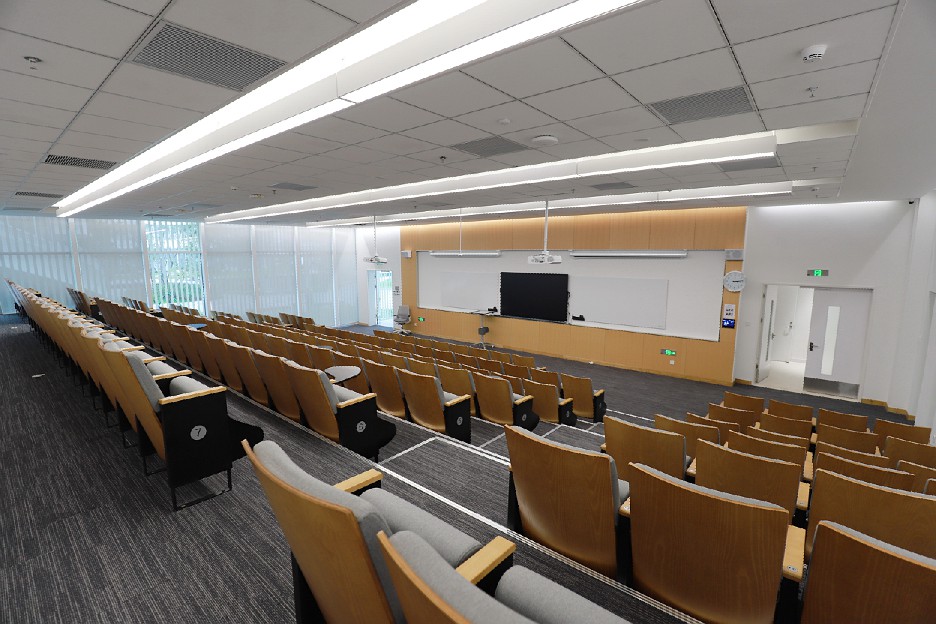
Designed for maximum density, fixed tiered seating is the staple of the large-scale lecture hall. Often constructed on a robust single pedestal base with permanent floor mounting, these units provide a clean, organized appearance, guaranteeing unobstructed sightlines for every student.
2. 360° Swivel Interactive Chairs
Equipped with pivoting bases on casters or turntables, many swivel seats also include integrated under-seat storage for personal items or course materials.
These chairs excel in collaborative classrooms, STEAM labs, and project-based learning environments where learners frequently shift attention between multiple displays or workstations.
3. Folding/Tip-Up Seats
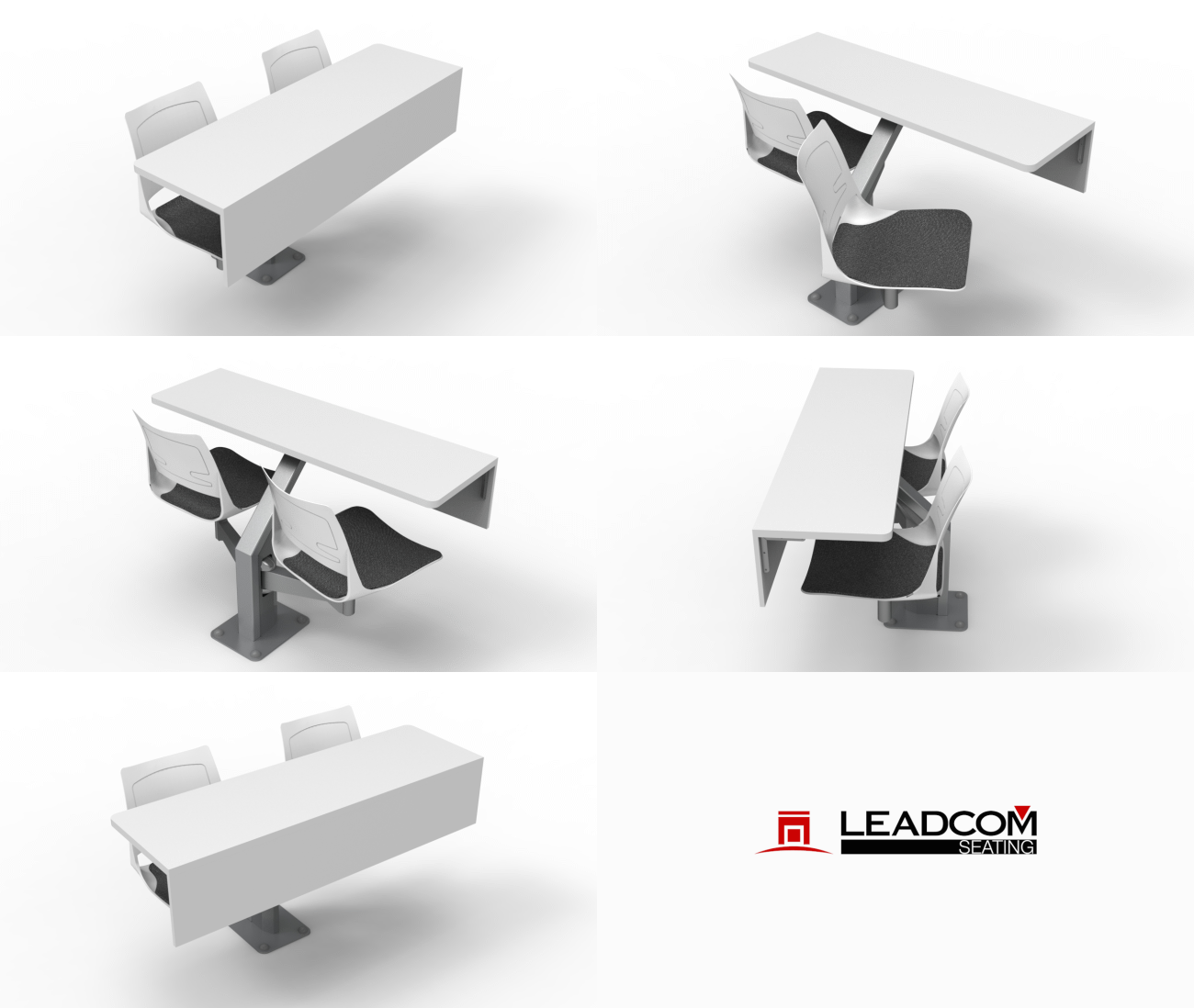
The defining characteristic of a tip-up seat is its self-retracting cushion mechanism. When the seat is unoccupied, the cushion automatically folds upward, creating an unobstructed path in the aisle.
Folding/tip-up seats minimize aisle obstructions and simplify cleaning between sessions. Common examples include convention halls, performing arts centers, and multi-purpose educational halls.
4. Mobile Tablet-Arm Chairs
The ultimate in flexibility, these individual chairs are equipped with high-performance casters. They enable a single classroom to be reconfigured from a standard row layout to a circle or U-shape in a matter of minutes, catering to various instructional needs.
Language laboratories, training suites, and adaptive learning spaces benefit most from this format.
5. Linked Row Seating
Row-linked lecture hall seating shows structural rigidity and visual uniformity. They boast unparalleled durability and ease of maintenance, keeping furniture securely in place and preventing gradual drift over time.
This chair type is commonly found in conventional public school classrooms and large-group instruction spaces such as lecture-based training facilities.
3. Folding/Tip-Up Seats
The defining characteristic of a tip-up seat is its self-retracting cushion mechanism. When the seat is unoccupied, the cushion automatically folds upward, creating an unobstructed path in the aisle.
Folding/tip-up seats minimize aisle obstructions and simplify cleaning between sessions. Common examples include convention halls, performing arts centers, and multi-purpose educational halls.
4. Mobile Tablet-Arm Chairs
The ultimate in flexibility, these individual chairs are equipped with high-performance casters. They enable a single classroom to be reconfigured from a standard row layout to a circle or U-shape in a matter of minutes, catering to various instructional needs.
Language laboratories, training suites, and adaptive learning spaces benefit most from this format.
5. Linked Row Seating
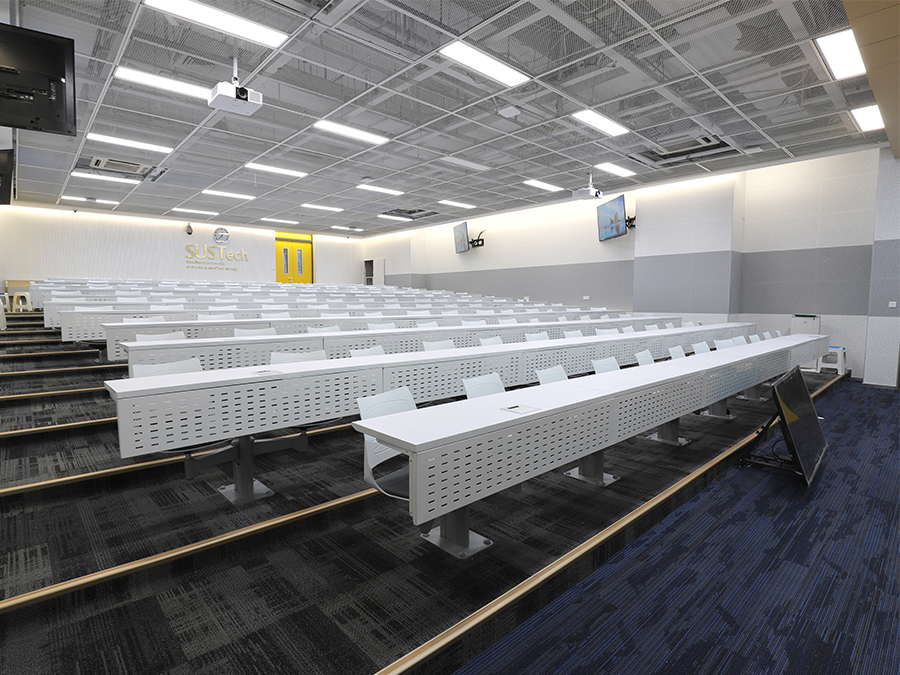
Row-linked lecture hall seating shows structural rigidity and visual uniformity. They boast unparalleled durability and ease of maintenance, keeping furniture securely in place and preventing gradual drift over time.
This chair type is commonly found in conventional public school classrooms and large-group instruction spaces such as lecture-based training facilities.

